Where US troops are; Iran’s response

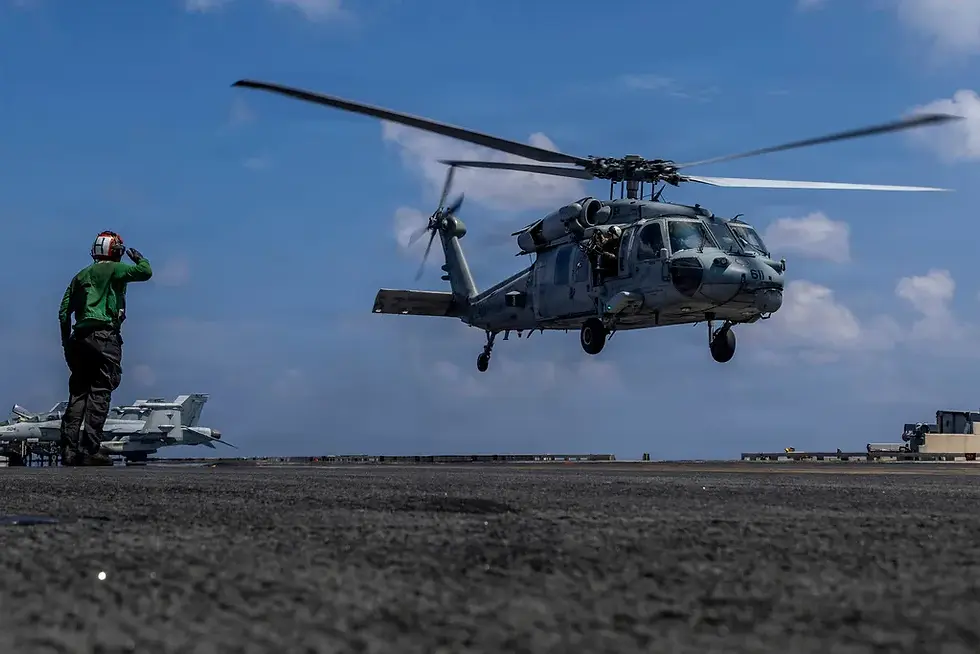
This handout image from the U.S. Navy shows Capt. Daniel Keeler, the commanding officer of the Nimitz-class aircraft carrier USS Abraham Lincoln, flying an MH-60R Sea Hawk helicopter in the Indian Ocean on Jan. 23, 2026. (Mass Communication Specialist Seaman Daniel Kimmelman/U.S. Navy via AP)
Greetings from Rome,
We’re watching the situation in Iran closely as American troops reposition in the region.
Here are a couple of things we’re keeping track of.
WHERE US TROOPS ARE
It’s no mystery by now that the United States has moved a massive amount of firepower into the Middle East. Chief among them, of course, is the USS Abraham Lincoln Carrier Strike Group, which is now in the Arabian Sea according to Central Command.
In the Israeli city of Eilat on the Red Sea, a U.S. destroyer was spotted making an apparent port call.
Speaking to reporters Friday, President Trump said the “armada” as he has described it is now even larger than what was used off the coast of Venezuela. And at this point, they’re not going anywhere.
“They have to float someplace,” Trump said. “They might as well float near Iran.”
The president wants a deal with the Regime that stops the crackdown on demonstrators and backs Tehran away from its Nuclear ambitions.
“I can say this. They do want to make a deal,” the president said, though he did not go further into details.
IRAN’S RESPONSE
So far, Iran has remained defiant, with Foreign Minister Abbas Araqchi saying this week they have their “fingers on the trigger” should the U.S. escalate the situation.
Friday, he was in Turkey meeting with his Turkish counterpart. Turkey acknowledged they are trying to play a mediating role between the U.S. and Iran. While the Iranians have said they are willing to negotiate with the U.S., they won’t do so under pressure or in regard to any conversation dealing with their national defense.
“I should also state unequivocally that Iran’s defensive and missile capabilities — and Iran’s missiles — will never be the subject of any negotiations,” Araqchi told reporters.
Separately, the Kremlin announced that Russian President Vladimir Putin received Iranian Supreme National Security Council Secretary Ali Larijani at the Kremlin. The two nations are allies and historically have bought and sold weapons from one another.
While the Kremlin did not give specifics on the conversation, so far, Russia has tried to steer clear of getting directly involved in Iran.
Meanwhile, the Iranians are preparing to hold what they describe as “live fire drills” in the Strait of Hormuz next week. That’s one of the most vital trade arteries in the world in which an estimated 20 million barrels of oil pass every day.
U.S. Central Command issued a warning today, telling the Iranians, “We will not tolerate unsafe IRGC actions, including overflight of U.S. military vessels engaged in flight operations, low-altitude or armed overflight of U.S. military assets when intentions are unclear, high-speed boat approaches on a collision course with U.S. military vessels, or weapons trained at U.S. forces.”
Much of the U.S. armada will be in close vicinity when those drills start next week.
THE SITUATION IN IRAN
We have been working with people on the ground in Iran this week to get a clear picture of what the situation is like. Rolling cellular blackouts have largely engulfed the country, brought on by the leadership in Iran, but some messages are able to get out.
Here’s what one woman told us in an interview.
“A very young boy, who looked to be about 20 years old, was next to me. He was shot in the head from a close distance and fell right there. I was scared; I couldn’t see anything; I was just running.”
Another Iranian said the following: “My message to the West, to Trump personally, and to others is: come help us. You might be calculating the political and economic costs, but our people are waiting for your help to move forward.”
AN UPDATE ON LESSONS FROM THE FRONT
If you happen to be in London on February 17, my first book event for “Lessons from the Front” will be held at The Frontline Club.
I’m pleased to share I will be chatting with Richard Gaisford, “Good Morning Britain’s” longtime chief correspondent, whose reporting has taken him to some of the most dangerous hotspots around the world over the last 26 years.
All of this is to mark our international publishing date of February 19. And for those who have been waiting for the audiobook release, that is set to happen February 10.


Comments